Design of Foundations for Dynamically Loaded Equipment
Fee: $1,645 / Online / Apr 7 - 9, 2027 / Course Code: 17-0426-ONL27
OVERVIEW
Please note, This instructor-led course has specific dates and times:
This course is held online over 3 days on the following schedule (All times in Eastern Time Zone): 11 am to 5:10 pm Eastern Time Daily Course Breakdown: 11:00 – 2:15, including one 15-minute break 40-minute lunch 2:55 – 5:10, including one 15-minute break You have the option to attend only Part 1 Intro, or the entire course.
By the end of this course, you will be able to:
- Calculate dynamic loads generated by common types of machinery
- Select appropriate foundation systems based on performance and soil conditions
- Analyze the dynamic response of shallow and pile-supported foundations
- Design tabletop structures to support equipment under dynamic loading
- Diagnose vibration issues and implement effective mitigation strategies
Description
When designing equipment foundations, you are responsible for ensuring stable performance under dynamic loads while accounting for soil behaviour, structural response, and vibration risks. Inadequate analysis or design decisions can lead to excessive movement, equipment damage, or long-term operational failures, particularly in challenging conditions such as frozen or expansive soils.
This course equips you with the practical tools and frameworks needed to evaluate and design foundations for dynamically loaded equipment. You will work through how machinery induces loads, how those loads interact with soils and structural systems, and how different foundation types perform under varying conditions. Emphasis is placed on analyzing dynamic response, selecting appropriate design approaches, and addressing vibration-related issues that affect reliability and safety.
Through applied examples and real-world case studies, you will learn how to model and verify foundation behaviour using industry software such as DYNA 6.1, alongside manual and finite-element approaches. By the end of the course, you will be able to confidently assess design options, validate results, and make informed engineering decisions that improve the performance and longevity of equipment foundation systems.
Who Should Attend
This course is designed for:
- Structural and consulting engineers involved in design of foundation for vibratory or moving equipment
- Field engineers working with industrial vibratory equipment
- Intermediate to senior professionals seeking to enhance their expertise in the subject with advanced knowledge and practical design skills.
Special Features
This course is presented in two syllabi: Introductory and Advanced. The Introductory course (I) covers the basic concepts of the design of equipment foundations, the use of DYNA 6.1 software for their dynamic analysis, calculation of dynamic loads for the most common types of machinery, and vibration damage risk assessment and prevention.
The Advanced course (A) targets skilled designers who want to learn how to solve complex design problems with a full understanding of structural behaviour. Participants will work on several examples under the instructor's guidance.
You have the option to attend only Part 1 Intro, or the entire course.
SYLLABUS
Day I
Welcome, Introduction, Course Preview, and Learning Objectives
Introduction to Design of Equipment Foundations (Introduction, Advanced)
Design objectives, design procedure, degrees of freedom, pure and coupled modes of vibration, free and forced vibrations, and resonance. Types of foundations and their uses: rigid block foundations, mat foundations, deep foundations, and the significance of damping. Anchorages for vibrating machinery.
Dynamic Soil Properties (Introduction, Advanced)
Small strain elastic moduli of soil, shear wave, compression wave, methods of soil exploration for dynamic problems, method of dynamic impedance
Methods of Analysis (based on example) - oil pump on pile foundation (Introduction, Advanced)
Demonstration of computer analysis using DYNA 6 software, its capabilities and limitations
Design of Shallow Foundations (Introduction, Advanced)
Theory of isotropic elastic half-space, the response of circular footings, shape factors for the response of non-circular footings, stiffness and damping functions, the effect of footing embedment, proximity of bedrock layers
Design Example (Introduction, Advanced)
Free vibration analysis of a rigid block foundation
Design of Shallow Foundations – additional chapters (Advanced)
Theory of layered elastic half-space, complex stiffness and damping functions, frequency dependence
Dynamically Loaded Foundations on Frozen and Expansive Soils (Advanced)
Frost effects, dynamic properties of frozen soil, design considerations, static and dynamic design criteria. Expansive soils, principles of foundation construction on expansive soils, types of foundations for dynamic machinery
Adjournment
Day II
Design of Pile Foundations - Single Piles (Introduction, Advanced)
Examples of piles applications, the effect of vibration on static pile design, stiffness and damping of single piles,
Design Example (Introduction, Advanced)
Common pump foundation on piles (illustrates the concept of “good” vs “bad” speed range for rotary machinery)
Dynamic Response of Vibratory Machinery Foundations (Introduction, Advanced)
Dynamic forces from reciprocating machinery, dynamic forces from rotary machinery, high-tuned and low-tuned foundations, normal and abnormal regimes
Dynamic Response of Impact Machinery Foundations (Introduction, Advanced)
Types of impact machinery, foundations for impact machinery, design criteria, derivation of impact forces, mathematical models and methods of solution, propagation of vibrations in the soil
Vibration Damage and Taking Suitable Remedial Measures (Introduction, Advanced)
Design criteria, resonance separation, admissible dynamic amplitudes and velocities, stationary and transitional resonance, problem assessment and evaluation, remedial principles and techniques
Design of Pile Foundations - Single Piles – additional chapters (Advanced)
Pile dynamic response - analytical methods, pile dynamic response using common FE software
Design of Pile Foundations - Pile Groups (Advanced)
Pile-soil-pile interaction, understanding of dynamic group effects, group factors calculation
Design Example – pile foundations – special chapters (Advanced)
Pump foundation on piles – case of layered and irregular soils
Dynamic Response of Vibratory Machinery Foundations – specialty chapters (Advanced)
Basics of rotor dynamics, critical and tripping speeds, dynamic loads from multiple pieces of equipment
Adjournment
Day III
Tabletop Structures (Advanced)
Definitions, modes of oscillation, foundation-structure interaction, stiffness and damping, static and dynamic design criteria, method of symbolic dynamic models
Methods of Analysis (based on example) - tabletop-mounted, turbine-driven centrifugal compressor (Advanced)
Hand analysis using MS Excel: generalized dynamic models, equations for free vibrations, equations for forced vibrations, interpretation of results
Methods of Analysis (based on example) - tabletop-mounted, turbine-driven centrifugal compressor (Advanced)
Demonstration of computer analysis using common FE software
Methods of Analysis (based on example) - skid-mounted reciprocating compressor (Advanced)
Hand analysis partially automated using common FE software: derivation of stiffness and inertial properties, pile group effects, equations for free vibrations, assessment of damping, equations for forced vibrations, interpretation of results, mitigation of excessive vibration
Open Forum
Questions and Answers and Feedback to Participants on Achievement of Learning Objectives
INSTRUCTOR
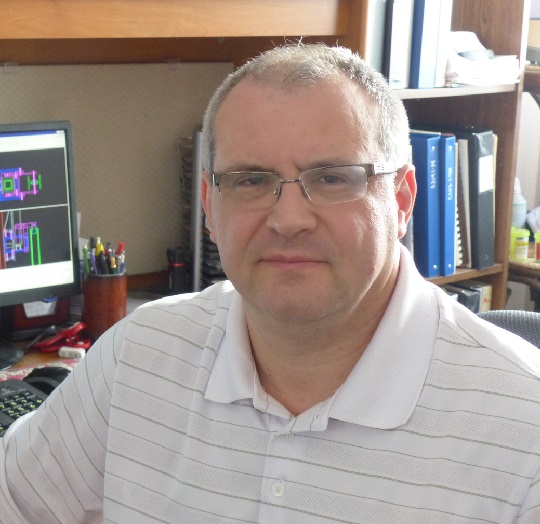
Senior Civil/Structural Engineer — Pro Dynamic Solutions Inc.
Edmonton, AB
Konstantin is the founder and principal of Pro Dynamic Solutions Inc, a research and industrial consulting company from Edmonton, AB.
Previous employment included senior and principal structural engineer positions with Jacobs Canada Ltd., ECO-Technica, Bantrel, Colt Engineering (presently Worley Parsons), Stantec Consulting and CoSyn Technology. He participated in major projects of expansion and construction of Alberta's oil and gas and petrochemical facilities. Konstantin graduated with honours from Moscow State Construction University, Faculty of Civil and Industrial Construction.
He studied at the graduate school of Central Research and Design Institute for Dwellings, Moscow. His Ph.D. thesis was devoted to the strength and seismic resistance of intercrossing (T-sectioned) load-bearing reinforced concrete structural walls in residential high-rise buildings. He conducts active, self-directed structural research driven by practical problems in industrial facilities design.
Konstantin is the author of more than 35 technical publications and has participated in numerous international conferences.
We always want to improve the quality of our courses. Please select any reasons why you feel this course is inadequate (check all that apply).
Thanks for the feedback.
Your input helps us improve EPIC's training programs.
We couldn't record that feedback.
This course's ID doesn't match anything in our records. Please refresh the page and try again, or contact registrations@epictraining.ca.